Before installing a time tracker on company laptops, many Indian business owners ask a reasonable question: are we allowed to do this? There is no single law that says "employee monitoring is permitted" or "forbidden". Instead, India's data protection framework sets out how personal data must be handled, and employment terms, contracts and sector rules add their own requirements. This guide explains the practical questions to answer. It is general information, not legal advice.
The law that matters most: the DPDP Act
The Digital Personal Data Protection Act, 2023 governs how organisations process digital personal data about individuals in India, including employees. The Digital Personal Data Protection Rules, 2025 were notified in November 2025, with obligations phasing in over roughly 18 months, so most core duties apply from around May 2027. Employers should prepare now rather than wait for the deadline.
Under the Act, the employer that decides why and how employee data is processed is the data fiduciary. A software provider that processes the data on the employer's instructions acts as a data processor. The responsibility for a fair monitoring policy therefore sits with the employer.
Questions to answer before you monitor
Writing these answers into a short policy is the most useful step you can take. It forces clarity about purpose and gives employees something concrete to read.
- What specific purpose does the monitoring serve, such as attendance, client billing or security?
- Is the data collected limited to what that purpose needs?
- Have employees been told clearly what is collected, when and by whom it is viewed?
- How long is the data kept, and how is it deleted?
- Who inside the company can access the records, and is access logged?
- How can an employee ask questions or correct a record?
Why data minimisation is the safest design
Keystroke logs, browsing histories, webcam captures and continuous screenshots collect far more personal information than a time-and-attendance purpose requires. They also capture incidental personal data such as banking pages or private messages. A tracker that records only timer events and input counts, with optional features switched off unless there is a clear need, is easier to justify and easier for employees to accept.
Notice and transparency in practice
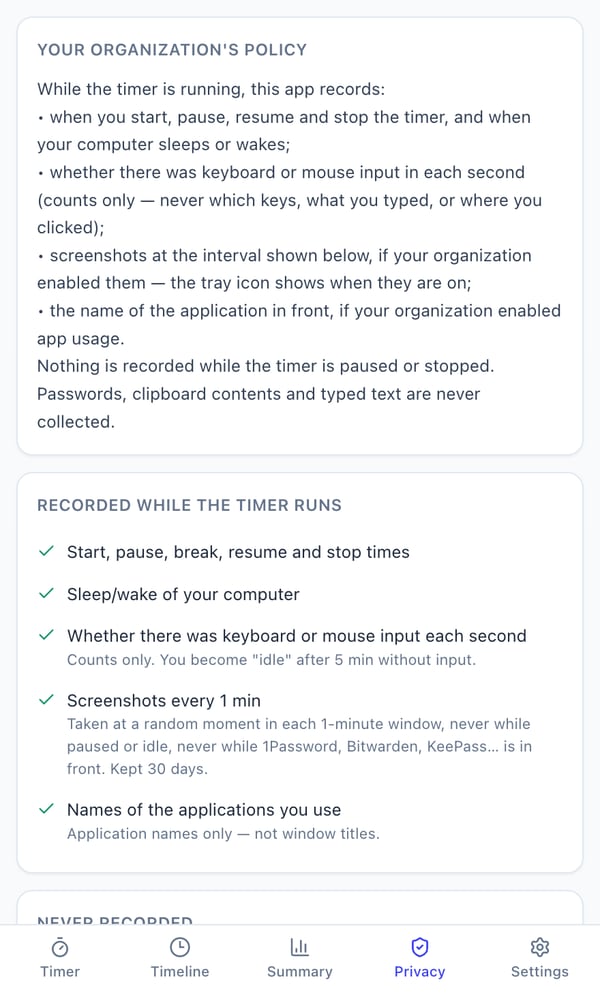
Tell employees before tracking starts, in writing, and keep the information available afterwards. The best notice is one employees can check at any time inside the tool itself, so they do not need to rely on memory of an onboarding email. Monitor company-owned devices for work purposes; extending monitoring to personal devices needs much more careful consideration.
How Pedinno Time Tracker is designed for minimal collection
Pedinno Time Tracker records timer events (start, pause, break, stop, sleep and wake), a periodic heartbeat and per-minute counts of seconds with keyboard or mouse input. Screenshots, the name of the application in front and, on Windows, window titles are recorded only if the organisation enables them. Typed text, key sequences, passwords, clipboard contents, URLs, camera, microphone and location are never collected, and nothing is recorded while the timer is paused or stopped. Employees can see what is recorded at any time in the Timer and Privacy tabs, and administrative actions are kept in an audit log.
Keep the policy under review
Revisit the monitoring policy when you enable a new feature, change retention or start using records for a new purpose such as performance reviews. Each change should be explained to employees before it takes effect. Take advice from a qualified lawyer for your sector and state, particularly if you operate in regulated industries or process data across borders.
Frequently asked questions
Can an employer in India track employee computer activity?
Employers commonly track work devices for legitimate purposes, but should follow the DPDP Act's principles: a clear purpose, notice, minimal data and reasonable security. Seek legal advice for your specific case.
When do the DPDP Rules apply?
The Rules were notified in November 2025 and phase in over about 18 months, with most core obligations applying from around May 2027.
Does Pedinno record keystrokes or browsing history?
No. It counts seconds with keyboard or mouse input and never collects typed text, passwords, clipboard contents or URLs.
Further reading
See Time Tracker in action
Transparent time tracking for Windows, macOS and Android — timers, activity levels, timelines, optional screenshots and daily, weekly and monthly reports.
Bring your draft monitoring policy and compare it with the Pedinno settings and the employee Privacy tab during the demo.
Explore Employee Time Tracker