A client asks for a quote on a project that will need two people for about three weeks. To price it properly, you need to know what one hour of each person's time actually costs the business, which is more than their salary divided by the hours in a month. The calculation takes ten minutes and changes how you look at pricing, overtime and client profitability.
Step 1: start from the annual cost to company
Begin with the employee's annual CTC, which in India usually includes the employer's contributions such as PF. If your CTC figure excludes any employer contributions, bonuses or benefits you pay, add them. This is the direct annual cost of employing the person.
Step 3: count real working hours in a year
Do not use 365 days. Start with working days, then remove holidays and leave. For a five-day week: 260 weekdays − 10 public holidays − 18 days of leave = 232 working days. At 8 hours a day, that is 1,856 working hours a year. Adjust for your own holiday list, leave policy and working week.
Worked example
An employee has a CTC of ₹6,00,000 and a share of overheads of ₹60,000, making a total annual cost of ₹6,60,000. With 1,856 working hours, the cost per working hour is ₹6,60,000 ÷ 1,856 = about ₹356. Not every hour is productive client work: internal meetings, training and administration take time too. If 75% of hours are billable or productive, that is 1,392 hours and the cost per productive hour is about ₹474. Price client work above this figure to cover profit and risk.
- Total annual cost = CTC + other employer costs + overhead share.
- Annual working hours = working days × daily hours.
- Cost per hour = total annual cost ÷ annual working hours.
- Cost per productive hour = total annual cost ÷ productive hours.
Why tracked hours make the number reliable
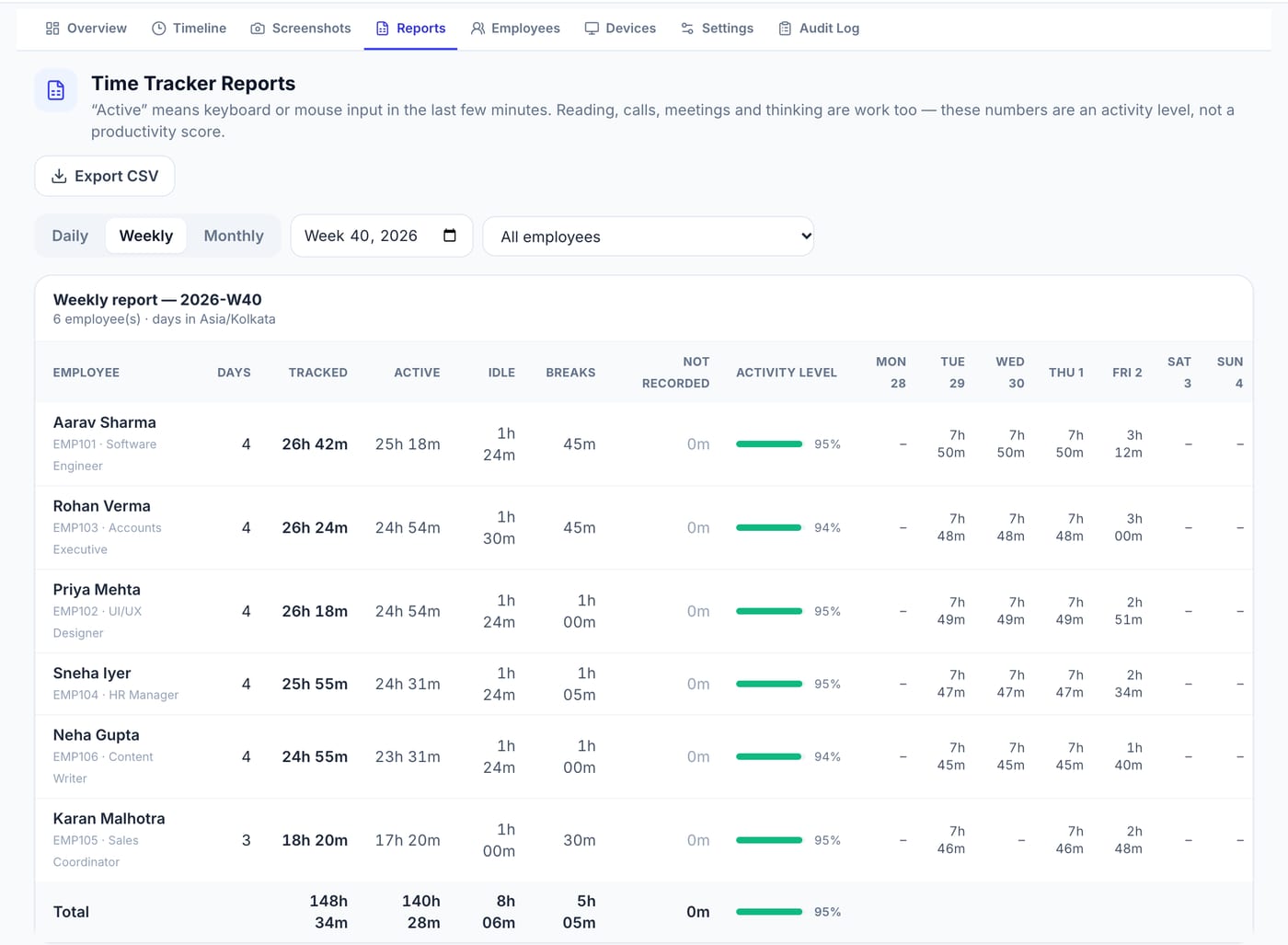
The weakest assumption in the calculation is usually the productive share. Many businesses guess 80% or 90%, and the real figure turns out to be much lower. A few months of time data replaces the guess with your own number, and also shows whether actual working hours are higher than the 8-hour standard because of regular overtime.
How Pedinno helps
Pedinno Time Tracker gives you daily, weekly and monthly totals of tracked, active, idle and break time for each employee, with CSV export for your own cost model. Use the free Pedinno salary calculator to sanity-check in-hand pay and statutory deductions, and Pedinno Payroll to keep salary costs connected to attendance.
See Pedinno Time Tracker reports
Frequently asked questions
How do you convert CTC to hourly cost?
Add overheads and any employer costs not in CTC, then divide by the employee's real annual working hours after holidays and leave.
How many working hours are in a year in India?
It depends on the working week, holidays and leave. A five-day week with 10 holidays and 18 leave days gives 232 days, or 1,856 hours at 8 hours a day.
Should I use cost per hour or cost per productive hour for pricing?
Use cost per productive hour, because clients only pay for productive time, while you pay for every hour.
See Time Tracker in action
Transparent time tracking for Windows, macOS and Android — timers, activity levels, timelines, optional screenshots and daily, weekly and monthly reports.
Bring anonymised CTC figures for one team and ask how a month of tracked hours would refine your cost-per-hour model.
Explore Employee Time Tracker