Every few months NVIDIA announces a faster AI platform, and every time business owners ask the same question: does this change anything for us? In 2026 the headline is Vera Rubin, the successor to the Blackwell generation that powered most large AI services over the last two years. Most companies will never buy a Vera Rubin rack, but they will feel its effects through the price, speed and capability of the AI services they use. This guide explains what Vera Rubin is, what NVIDIA claims for it and how to think about it as a buyer of AI software.
What Vera Rubin is
Vera Rubin is NVIDIA's data-centre AI platform for 2026 and 2027. The name covers two chips that work as a pair: the Rubin GPU, which does the heavy mathematics of training and running AI models, and the Vera CPU, which handles data movement, scheduling and the general-purpose work around it. They are sold mainly as complete rack-scale systems, such as the Vera Rubin NVL72, in which 72 GPUs are linked by NVIDIA's NVLink so they behave like one very large accelerator.
Around the chips sits a full platform: BlueField-4 data processing units for networking and security, Spectrum-X Ethernet switches, including versions with co-packaged optics, and software for running the whole data centre as what NVIDIA calls an AI factory.
How it differs from Blackwell
Blackwell, launched in 2024 and 2025, was designed when most AI traffic was people chatting with a model. Vera Rubin is designed for agentic AI, where a model plans, calls tools, reads long documents and generates many more tokens per task. NVIDIA says the platform delivers up to ten times the agent throughput of the previous Grace Blackwell platform at scale. That is a vendor figure for large deployments, not a benchmark you will see on your own invoice, but the direction is clear: more work per rack and per unit of power.
- Faster memory (HBM4) so the GPU spends less time waiting for model weights and context.
- A new CPU, Vera, built for feeding data to GPUs and running agent orchestration.
- Higher-bandwidth NVLink and networking so very large models can be split across many chips.
- Confidential computing support, so data can stay encrypted while the model processes it.
When it becomes available
NVIDIA announced at the end of May 2026 that Vera Rubin was in full production, with production shipments starting in the autumn. Large cloud providers and specialist GPU clouds receive systems first, and server makers such as Dell, HPE, Lenovo and Supermicro build their own Vera Rubin servers. NVIDIA has also announced a containerised version that packs several racks into a shipping container, with deliveries expected from early 2027. For most businesses, the practical route to Vera Rubin will be a cloud AI service or GPU rental running on it, not a purchase.
What it means for businesses that use AI
The biggest effect is on the cost and speed of AI services. Each new generation has lowered the cost of producing a token of AI output, and model providers have passed much of that saving on as lower prices or more capable models at the same price. Tasks that were too expensive to automate a year ago, such as reading every page of every supplier invoice or letting an assistant run multi-step research across your ERP data, become reasonable as the cost per task falls.
It does not mean you need to change your AI plans or wait. Software built on a good model today will usually run faster and cheaper as providers move to newer hardware, without any change on your side. The more important decisions remain the business ones: which processes to automate, how clean your data is and where people must approve the result.
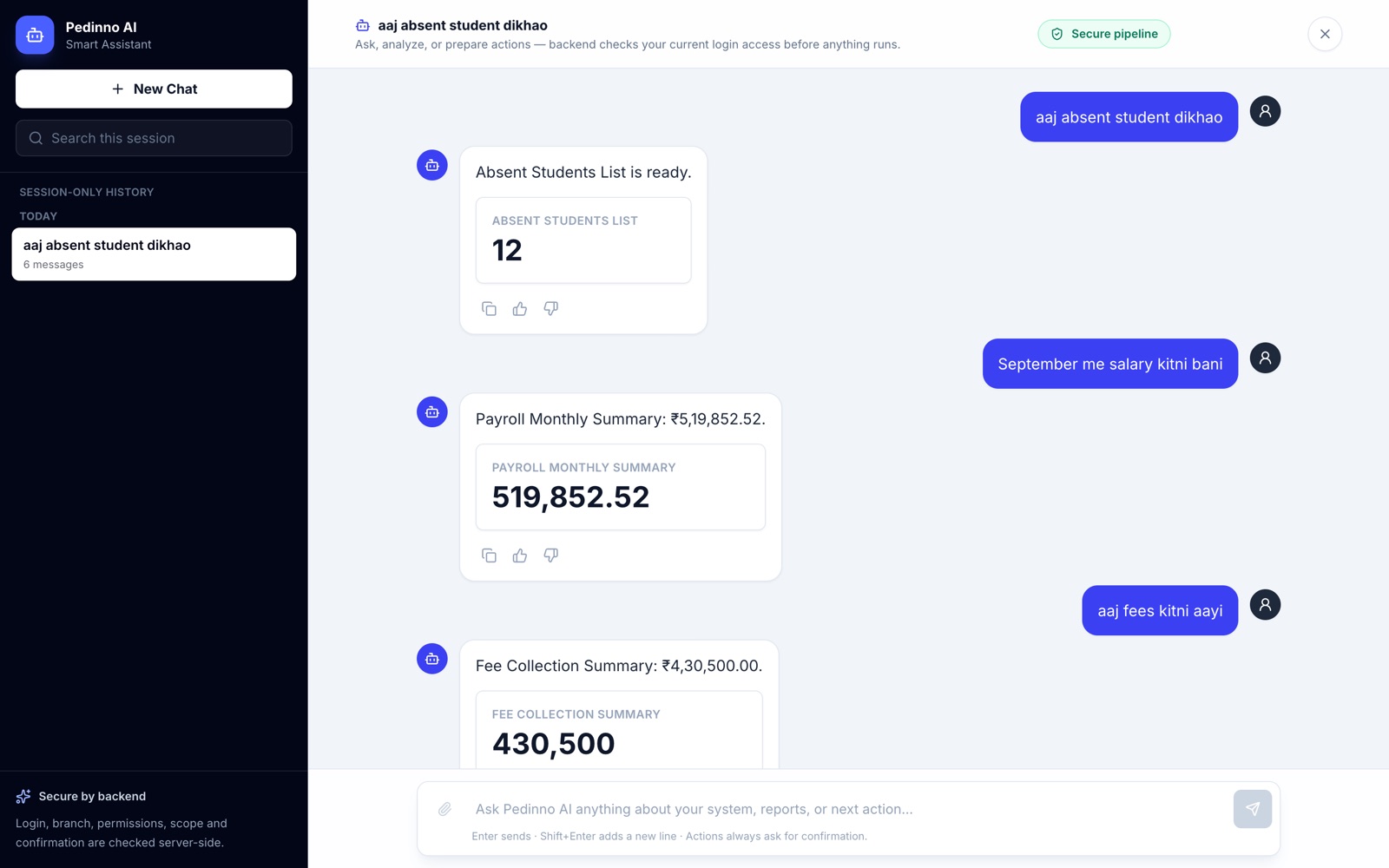
See how Pedinno AI Assistant answers questions from your business data
Questions to ask an AI vendor
- Which model and which cloud region does your service run on, and can that change without notice?
- Is pricing per user, per document or per token, and how have prices moved as hardware improved?
- Can the service move to a newer or cheaper model without us rebuilding our workflows?
- Where is our data processed and stored, and is it used to train anyone's models?
How Pedinno chooses models and infrastructure for AI projects
Frequently asked questions
Should my company buy NVIDIA Vera Rubin hardware?
Almost certainly not. Vera Rubin is sold as rack-scale systems for data centres. Most businesses benefit from it through cloud AI services and GPU rental that run on it.
Will Vera Rubin make AI services cheaper?
Newer hardware lowers the cost of producing AI output, and providers have historically passed part of that on. Actual prices depend on each provider and on demand.
Do we need to wait for Vera Rubin before starting an AI project?
No. Well-designed AI software runs on whatever hardware the model provider uses, and usually gets faster and cheaper as providers upgrade.